
You have launched your startup in Vashi, Nerul, Kharghar or Airoli, your product is ready, and you have set aside ₹50,000 for ads. The next question decides whether that money becomes customers or disappears in a month: where should it go?
As a performance marketing expert in Navi Mumbai, I manage live ad accounts for clients across EdTech, engineering, e-commerce and services. The pattern is consistent. Startups rarely fail because the budget is small. They fail because they spend it in the wrong order. This guide shows you the order I recommend.
What Is Performance Marketing (and Why It Suits Startups)?
Performance marketing is paid advertising where you pay for measurable results such as clicks, leads or sales, rather than for vague visibility. Every rupee can be tracked to an outcome, which matters when you do not have money to waste.
Unlike brand advertising, you can start small, learn quickly and scale only what works.
Before You Spend: Set the Foundation (10-15% of Budget)
The most common mistake I see during ad account audits is launching campaigns before the basics are ready. Set aside roughly ₹5,000-₹7,500 for:
- Conversion tracking: Google Tag Manager, GA4 and the Meta Pixel, with form submissions and WhatsApp clicks tracked as events.
- A focused landing page: One offer, one call to action, fast on mobile. Most Indian ad traffic arrives on phones.
- Creative assets: Three to five ad creatives or short videos that show your offer clearly.
Skipping this step means you cannot tell which ads work, and you end up paying for guesswork.
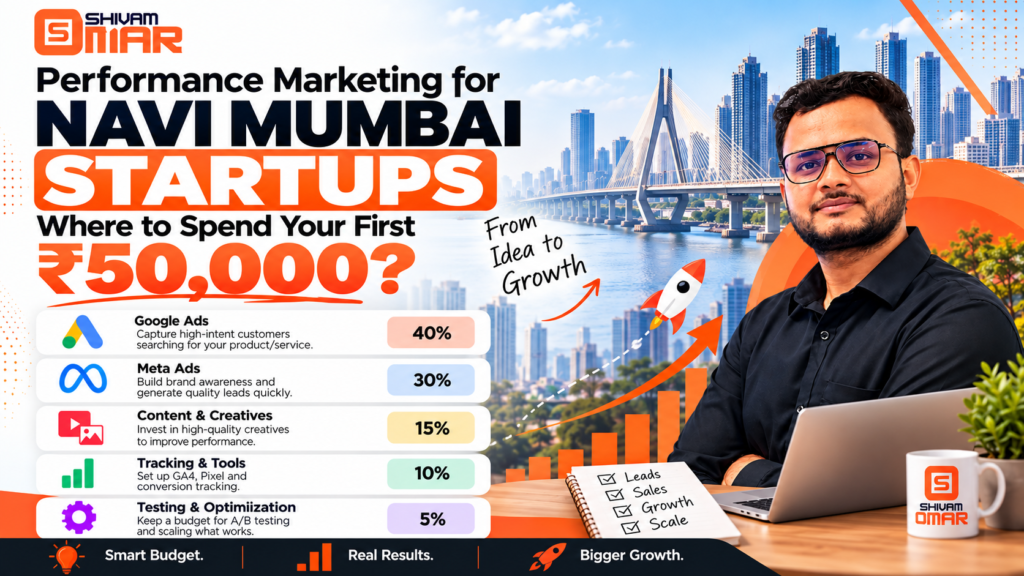
A Practical ₹50,000 Budget Split
This is a starting framework, not a fixed rule. Adjust it to your industry and sales cycle.
| Channel | Budget | Share | Purpose |
|---|---|---|---|
| Setup, tracking and creatives | ₹7,500 | 15% | Foundation |
| Google Search Ads | ₹15,000 | 30% | Capture people already searching |
| Meta Ads (Facebook and Instagram) | ₹17,500 | 35% | Create demand and generate leads |
| Retargeting | ₹5,000 | 10% | Bring back visitors who did not convert |
| Testing reserve | ₹5,000 | 10% | Double down on what works |
1. Google Search Ads: Capture Existing Demand
If people already search for what you sell, Google Search gets you in front of them at the moment of intent. A Kharghar dental clinic, a Vashi coaching institute or a Navi Mumbai interior designer can target searches like “[service] near me” or “[service] in Navi Mumbai.”
Start with 10-15 tightly themed keywords, use exact and phrase match, and add negative keywords from day one to block irrelevant clicks.
2. Meta Ads: Generate Demand and Leads
When people do not yet know your solution exists, Meta (Facebook and Instagram) is stronger. It works well for EdTech, e-commerce, real estate and local services.
Target Navi Mumbai and nearby areas with a radius, and test two or three audiences against two or three creatives. Let the data decide before you scale.
3. Retargeting: The Cheapest Conversions You Will Get
Someone who visited your site but did not enquire is warmer than a stranger. A small retargeting budget usually brings a lower cost per lead than cold traffic.
4. Keep a Testing Reserve
Hold back about 10%. In the first two weeks you will discover which ad, audience or keyword is winning. The reserve lets you back it immediately instead of waiting for next month’s budget.
The Metrics to Track
Ignore vanity numbers like impressions. Focus on:
- CPL (Cost Per Lead): What one enquiry costs you.
- Lead quality: How many leads are genuine and reachable.
- CAC (Customer Acquisition Cost): What one paying customer costs.
- ROAS (Return on Ad Spend): Revenue earned per rupee spent, especially for e-commerce.
Cheap leads are not automatically good leads. A ₹150 lead who never picks up the phone costs more than a ₹400 lead who buys.
A Realistic 60-Day Timeline
- Days 1-7: Set up tracking, landing page and campaigns.
- Days 8-30: Learning phase. Review data every few days, pause weak ads and refine targeting.
- Days 31-60: Shift budget to winning campaigns and add retargeting.
Expect the first month to be about learning. Be cautious of anyone who promises guaranteed sales in week one. Results depend on your offer, pricing, industry competition and how fast your team follows up on leads.
Common Mistakes to Avoid
- Boosting posts instead of running proper campaigns.
- Sending traffic to the homepage instead of a dedicated landing page.
- Changing campaigns every day, which resets the platform’s learning.
- Ignoring follow-up. Leads that get a call within minutes convert far better.
- Spreading ₹50,000 across five platforms instead of mastering two.
When to Hire a Performance Marketing Expert
If you can spend time learning the platforms, you can run the first month yourself. If your time is better spent on the product and sales, hiring an expert saves money because mistakes on a small budget are expensive.
Look for someone who shows real account experience, explains their process openly, gives you access to your own ad accounts, and reports on leads and revenue rather than just clicks.
Is ₹50,000 enough to start performance marketing?
Yes, for a focused start with one offer and one or two channels. It is enough to gather data and find what works, not to scale aggressively.
Frequently Asked Questions
Should a startup start with Google Ads or Meta Ads?
If customers actively search for your service, start with Google. If your product needs awareness first, lead with Meta. Most startups benefit from both, in the split above.
How long before I see results?
You can get leads within days, but expect 30-60 days to optimise into a stable cost per lead.
Does the ₹50,000 include agency fees?
Ad spend and management fees are separate. Confirm this before signing with anyone.
How much should I spend on ads versus setup?
Around 10-15% on setup is a healthy range, and the rest goes to ads and testing.
Final Thoughts
Your first ₹50,000 is a learning budget as much as a growth budget. Build the tracking foundation, start with the channels closest to buying intent, keep a reserve to back winners, and judge success by lead quality, not clicks.
If you want a customised budget plan for your business, get in touch through the contact page for a consultation.
About the Author
Shivam Omar is a Performance Marketing trainer at SkillCircle and the founder of Growth Loop Marketing Agency, where he manages live Meta and Google ad accounts for clients across EdTech, engineering, e-commerce and services. He trains and mentors marketers on the same strategies he applies to real campaigns. Learn more at shivamomar.in.